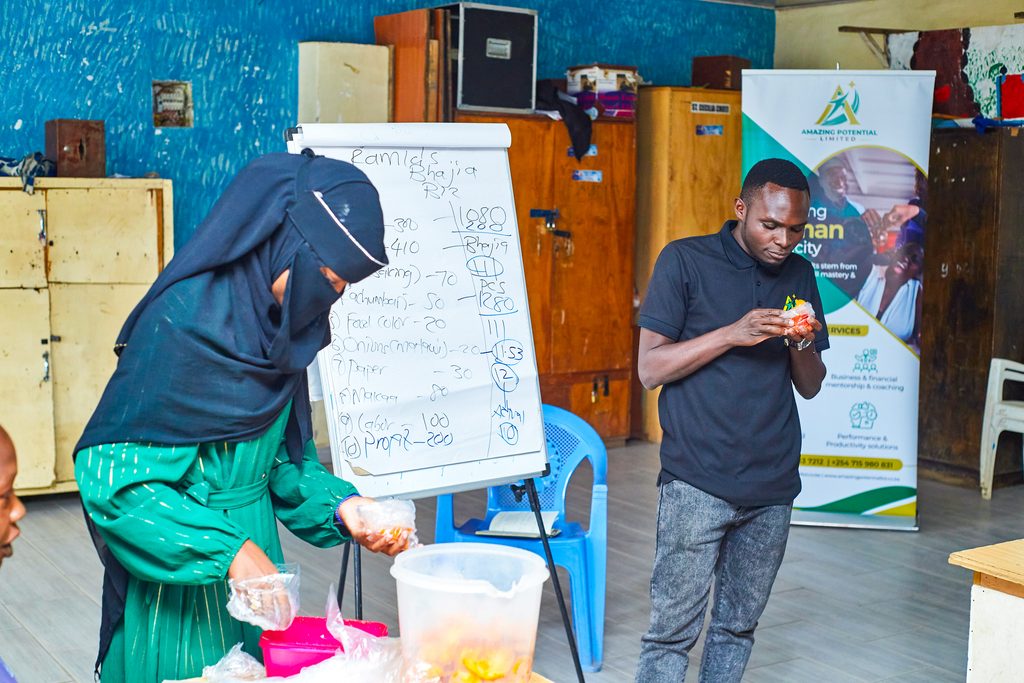
A training room can be a place where people listen, take notes and exchange ideas. But sometimes, something more important happens. An idea leaves the training room and becomes action.
This is what we witnessed during a three-day entrepreneurship and capacity development training that Amazing Potential Ltd conducted in Mukuru Kwa Njenga in partnership with World Concern.
The training brought together 20 participants to explore personal potential, opportunity identification, entrepreneurship, business development, marketing and practical application.
But the most interesting part was not simply what was discussed. It was what started happening during the training.
The gap between knowing and doing
Training can give people information. But information alone does not necessarily change behaviour. Someone can understand entrepreneurship without ever starting a business. Someone can learn how to identify opportunities but continue walking past problems that could become opportunities.
This is why, at APL, we are interested in the space between learning and action.
What happens when people are given not only knowledge, but also an opportunity to apply it? That question became particularly visible during the Mukuru training.
Starting with potential
The training began by encouraging participants to think about their own potential and capacity. Entrepreneurship is not only about having a business idea. It also requires the ability to identify problems, recognise opportunities, make decisions, take initiative and learn from experience.
When people begin to see themselves as capable of creating value, their relationship with their environment can also change. A challenge can become a problem worth solving. A skill can become something that can be offered to a customer. An everyday activity can reveal a possible business opportunity. That shift in perspective is an important part of entrepreneurship development.
From opportunity to business idea
The training then moved into practical entrepreneurship. Participants explored opportunity identification, customers, value creation and the Business Model Canvas, helping them begin to structure and test their ideas.
Instead of asking only:
“What business can I start?”
participants could begin asking better questions:
What problem am I solving?
Who experiences this problem?
What value can I create?
How will I reach the people I want to serve?
How will the idea generate income?
These questions move entrepreneurship beyond simply having an idea and towards understanding whether that idea can create value.
When learning became action
One of the most interesting developments during the training was that half of the participants—10 out of the 20—started the training without businesses. By the third day, two participants had started businesses, brought their products to the training and sold them to fellow participants. That represents 10% of the total participants.
But the number itself is only part of the story. What matters is what it represents.
Two people moved from discussing entrepreneurship to testing something in the real world within the period of the training.
They did not wait until the training was over. They took an idea, created something and put it in front of potential customers. That is the moment when learning begins to become action.
The training room became a small marketplace
There is something powerful about practical application. When participants sell to other participants, the training room changes. The learner becomes an entrepreneur. The participant becomes a seller. The fellow participant becomes a potential customer.
Suddenly, concepts such as customer value, pricing, marketing and product development are no longer abstract ideas on a presentation slide.
They become real questions.
Will someone buy this?
What do they like about it?
What could be improved?
How should I present it?
What happens if nobody buys?
These are lessons that are difficult to fully capture through theory alone.
Small action can create a different kind of confidence
Starting a business during a training does not automatically mean that the business will succeed. We cannot yet say what revenue these businesses will generate, whether they will survive long-term or whether they will become sustainable sources of income. Those questions require follow-up.
But something observable happened during the training:
participants acted on what they were learning.
And that matters. Confidence can grow differently when someone moves from:
“I think I can do this.”
“I actually tried it.”
to:
The second statement contains experience.
What this means for training
The Mukuru experience reinforces an important lesson for anyone designing capacity-building programs:
Training should create opportunities for application.
People need space to test ideas. They need opportunities to work together. They need feedback. They need to make decisions. They need to experience the consequences of those decisions. And sometimes, they need an environment where taking the first step feels possible. This is why practical exercises, group work, real-world examples and action-oriented learning matter. They help close the distance between understanding something and actually doing it.
The real test begins after the training
There is still another part of the story. The end of a training is not the same thing as transformation being complete.
The next questions are what happen after participants return to their everyday environments.
Do the businesses continue?
Do participants keep testing their ideas?
Do they find customers?
What challenges do they encounter?
What skills do they discover they still need?
What support would help them move forward?
These are questions that follow-up can help answer.
For APL and World Concern, the Mukuru training therefore represents more than a three-day activity. It provides an opportunity to observe what happens when people are given knowledge, practical tools and space to act.
From potential to action
At Amazing Potential Ltd, we believe human capacity development is most meaningful when it helps people move from potential to possibility, and from possibility to action. The two businesses that emerged during the Mukuru training are a small but important example of that movement. Ten participants entered the training without businesses. Two had started businesses and were already selling their products by the third day.
We don’t yet know where those businesses will be six months or one year from now.
But we know where they started.
They started with an idea, an opportunity and the willingness to act.
And sometimes, that first action is where transformation begins.
- Meet Wigan Kemp: The Dandora Artist Championing Men’s Mental Wellness Through Music and Mentorship
- WECYPWD Works to Bring Disability Therapy Closer to Families in Soweto
- SIYB Game Brings Practical Business Learning to 50 Participants in Mukuru
- Embakasi West PWD Centre Brings Therapy, Support and Empowerment Closer to Persons with Disabilities
- “You are the first line of defense against suicide” Experts urge